Passing It On
Thinking Across Generations about Money, Time and Purpose

Passing It On: Thinking Across Generations about Money, Time, and Purpose
Prologue
This post is a draft introduction of my book in progress. It’s the first of a series of postings related to the book, and to thinking more broadly about family and economic life. Consider it a thesis statement: I’ll be adding provisos and nuance in the months ahead. In the meantime, comments are welcome. Feel free to share this post with anyone who you think would profit from it. And if it piques your interest, subscribe to my Substack -- for free if you want to be sure to get your money’s worth; for $80 if you want to help me support my grandchildren.
Future postings on this topic (about one every other week, usually on Thursdays) will include:
How Not to Think about Having Children
The Family Under Capitalism: A Brief Overview
Is Capitalism Biologically Self-Undermining?: Revisiting an Interwar Argument
The XX Factor: The Changed Position of Women
Clashing Time Frames: Women’s Bodies and Men’s Obliviousness
Passing on Culture: The Rich Possibilities of Raising Cultured Kids
Work from Home: Costs and Benefits
I’ll be posting on other topics as well.
Passing It On: Thinking Across Generations about Money, Time, and Purpose
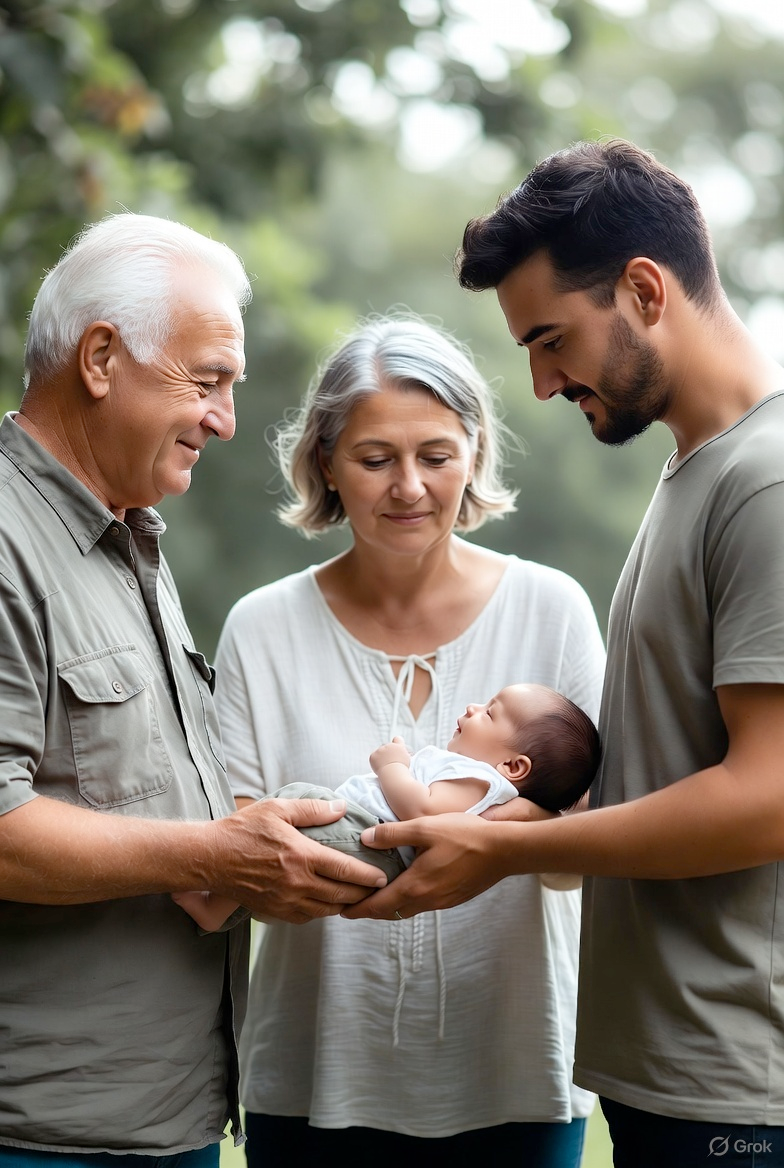
One thing in life is certain: you’re going to die. Oddly enough, that fact can be liberating. Remembering that life has an endpoint helps you live it so that it has a point—a direction, a storyline, something more than a string of disconnected “experiences.” To have grandchildren is to know that your life has gone somewhere, that it extends beyond the tight circle of the self. Grandchildren create a sense that your life has continuity and consequence.
Some people—often brilliant or accomplished by worldly standards—struggle with this. They think of their lives as a chain of experiences, personal achievements, or creative contributions. When death approaches, they feel as though the curtain is falling on a one-person show. Marguerite Duras wrote late in life, “I cannot reconcile myself to being nothing.” Susan Sontag said, “Death is unbearable unless you can get beyond the ‘I’”. Yet, as her son observed, she never managed to do exactly that. Neither Duras nor Sontag had grandchildren, nor does it appear that the thought much concerned them. Thinking about grandparenthood requires stepping beyond the gravitational pull of the “I.”
Why Grandparenthood Matters
Grandparenthood offers one of life’s deepest forms of joy—a joy strangely neglected in our culture. We speak readily of travel, food, or professional achievement, but rarely of the quiet exhilaration of watching a new life branch from our own. This absence is revealing: modern societies celebrate self-expression more easily than generativity.
Psychologists like to tell us that experiences bring more happiness than things—that a trip to the Swiss Alps will give deeper satisfaction than a new couch. Perhaps. I’ve had such experiences; the Alps and Patagonia are unforgettable. Yet nothing compares, not even remotely, to hugging my grandchildren. Publishing a book has brought gratification, but again, no comparison.
Among educated middle-class Baby Boomers (and the generations just after them), grandparenthood is often a quiet, even secret pleasure. Many don’t experience it because their children didn’t marry, or married too late to have children, or had them at an age when the grandparents can no longer enjoy them. To speak openly about the joy of grandchildren feels like gloating or inflicting pain. Our society treats grandparenthood as almost undiscussable—rarely portrayed seriously in literature, film, or the self-help genre, except as comic relief. And yet surveys consistently show how important it is to those who experience it.
When I speak of the joy of grandparenthood, I don’t only mean the direct pleasure of being with grandchildren. I mean the condition of knowing that one is a grandparent. A friend of mine confessed that the moment she learned her daughter was pregnant, she experienced a surge of joy unlike anything before.
So why don’t we talk about it? Partly because being a grandparent signals age, and people fear being perceived as old—professionally, socially, erotically. But the deeper reasons are harder to articulate.
The Many Layers of the Pleasure
Some of the pleasures of grandparenthood are frankly biological. There is the intense satisfaction of genetic continuity: seeing a grandchild and thinking, “He looks like me,” or “She has my mother’s eyes.” Kin-selection theory notes that grandparents share 25% of their genes with their grandchildren; we are wired to care about this. And there is also the delight of genetic novelty—the unexpected variations that arise when two family lines intertwine.
Other pleasures are spiritual. Grandparenthood offers a sense of legacy, of participating in something that continues after you’re gone. For most of us, this is the closest we’ll get to immortality. A few people may leave their mark through great professional accomplishment or artistic creation or philanthropic contributions. But for most human beings, the deepest and most enduring mark we make on the world is through the people we create, nurture, and launch into it.
This runs counter to the modern cult of self-realization, which treats personal fulfillment as the highest good. But the philosopher Josiah Royce, quoted by Atul Gawande in Being Mortal, observed that human beings need dedication to a cause beyond themselves. It may not always make us happy, but without such devotion, life becomes less bearable. Gawande notes that, as we age, our ambitions shrink even as our concern for our legacy grows. Grandchildren give that concern an object.
Having children is the first step; this is how we create and nurture life. Children demand sacrifice—time, money, energy, emotional labor. They don’t necessarily produce steady happiness. But in the long run they create something deeper: joy, in the sense of aligning a natural impulse with a larger meaning. Grandparenthood, especially when the intervening generation is doing the hard work of daily child-rearing, brings the joys of parenthood with far fewer costs. It is pleasure without responsibility.
Reawakening Wonder
Children experience the world with immediacy. One of the quiet gifts of spending time with grandchildren is rediscovering the world through their unfiltered senses—its sounds, smells, textures. Watching them smell spices for the first time or stare at an insect with total fascination reminds us how dulled our own perceptions have become.
There is also the fascination of development. A newborn learning to hold up its head is a monumental achievement, though we forget this when we haven’t spent time with infants. Then come the milestones: crawling, walking, the extraordinary leap from comprehension without speech to syllables, words, fragments, and finally sentences. Each stage is a marvel. And the stages go on and on.
The Intergenerational Circle
Another pleasure of grandparenthood is its effect on relationships with our adult children. Becoming parents can deepen their understanding of what we did for them. They see, often for the first time, how demanding and how loving parenting truly is.
Grandparenthood also offers the chance to practice a distinct set of virtues. Parents must often embody justice—rules, boundaries, consequences. Grandparents can, on occasion, embody mercy: the slightly indulgent voice that says yes when the world is full of no. Parental love must sometimes be conditional; grandparental love can afford to be unconditional, so long as it doesn’t interfere with parenting itself.
And then there is the simple arithmetic of love: grandchildren give us more people to love. Human beings naturally care most for those genetically closest to them, and each grandchild is a new node of affection—utterly unique, requiring different understanding and attention.
A Stake in the Future
As people age, their horizons tend to shrink. We withdraw from wider concerns, sometimes out of physical limitation, sometimes out of emotional fatigue. And yet our need for meaning grows. Grandchildren counteract this contraction by giving us a stake in the future. They tether us to the world our descendants will inhabit and make us care more deeply about what comes next.
In short, grandchildren add years to your life—and life to your years.
Getting to Grandparenthood
If grandparenthood is one of life’s deep pleasures, then the most obvious question follows: How do you get there? It sounds simple—have children, and hope that they have children. But in practice, becoming a grandparent while still young and vigorous enough to enjoy it requires a kind of long-term thinking that contemporary life almost never encourages.
To be a grandparent at sixty or sixty-five, you cannot begin thinking about it at fifty-eight, or fifty-five, or even fifty. You must have children of your own early enough for them to reach marriage and childbearing age while they are still fertile—and that means they are most likely to do so in their twenties or early thirties. Which in turn means you need to have had your children (or at least started) by your own late twenties or early thirties.
This simple arithmetic immediately puts one at odds with several powerful trends in modern society. Today, anyone aspiring to middle-class stability is told—correctly—that advanced education is essential. That is as true for women as for men, and genuinely a moral gain of the last century. But it means that the years once associated with family formation are now spent in classrooms or laboratories, far from the habits and rhythms that lead to marriage and parenthood.
Add to this the cultural ideal of “establishing oneself” before marrying or having children—not only financially but professionally, emotionally, and psychologically. Many young adults feel they must first become fully realized, fully formed individuals before contemplating family life. And hovering over all this is the now-institutionalized idea of one’s twenties as a decade of experimentation and self-discovery. Social scientists have even given it a name: emerging adulthood, a liminal stage in which “thirty is the new twenty.” But biology has not received the memo; fertility has not shifted with social expectations.
Put these trends together and a significant problem emerges: more and more people finally reach full adulthood and turn toward partnership and family at precisely the moment when the pool of desirable partners is shrinking and their own capacity to have children is narrowing. It is entirely possible to wake up at thirty-five or forty and realize, often with genuine shock, that the window has grown small.
The younger you are when you have children, the younger you will be when they have children. If you have your first child in your late thirties or forties, and your child does the same, you may not become a grandparent until your seventies or later. At that stage, health, stamina, and mobility inevitably limit the time and kinds of connection you can enjoy.By contrast, early grandparenthood provides the gift of time—the most precious resource in human life. It gives more years for grandchildren to know their grandparents, and more years for grandparents to shape and delight in the lives of their grandchildren.
In this sense, planning for grandparenthood is planning for the richest form of old age, the one filled with continuity, connection, and meaning. And that planning begins long before the first grandchild arrives, indeed, before the first child arrives. It begins with a vision of one’s life as part of something larger and more enduring than oneself.
A Counter-Cultural Project
My project – first in some of these postings, and then in a book -- is about planning your life so that you can enjoy the pleasures of grandparenthood while you are still able to appreciate them. Some will object that such things cannot be planned—that life is too unpredictable, that children come when they come, that marriage is a matter of timing, chemistry, and fate. And there is truth in that. Life is shot through with contingencies, setbacks, and unexpected opportunities; no plan comes with a guarantee.
But the fact that a plan may fail is not a reason to avoid planning. Most middle- and upper-class people try to plan their careers, knowing full well that jobs vanish, markets collapse, bosses change, and industries transform. Yet people plan anyway because intentionality improves one’s odds. Family formation deserves the same seriousness.
In many respects, the message here is counter-cultural. For at least two generations, educated people have absorbed the idea—partly through the work of Abraham Maslow—that the highest good is self-realization. Professional attainment, not family continuity, has become the central narrative of a successful life. A friend once summarized the ethos of elite American education this way: you are the most privileged generation in human history; therefore, you must justify that privilege by constant striving. You must compete for the next credential, the next job, the next grant, the next award. You must always be working.
And alongside this comes another pressure: as adults observe helicopter parenting, intensive parenting, and the rising bar of parental expectations, they conclude—often subconsciously—that having children requires a total reorientation of their life. It is easier, then, to delay. And delay. And delay again. The older one becomes, the more one’s work habits feel like one’s identity, and the more parenting feels like a deviation from it. Under these pressures, family life becomes fragile, tentative, postponed indefinitely.
Yet this model of life is built on shaky ground. In a dynamic economy, professional opportunities open and close unpredictably. To make one’s career the foundation of one’s identity is to build on quicksand. Which makes it all the more important to cultivate an alternative anchor—family, continuity, and the long-term project of raising the next generations.
So my project asks directly: what are the tradeoffs of structuring life around delayed marriage, episodic relationships, or perpetual professional striving? How does one weigh those tradeoffs against the joys of long-term connectedness? One of the hardest tasks of young adulthood is imagining one’s life at later stages—imagining oneself at fifty, sixty, seventy. But this is precisely what we must do if we want to align the choices of our twenties with the satisfactions of our later years.
The modern impulse to “define meaning for oneself” is noble in spirit but incomplete in practice. Much meaning arises not from autonomous self-invention but from being part of a chain of generations—from inheriting, transmitting, and belonging. As the late sociologist, Ralf Dahrendorf, argued, life chances are not just opportunities but linkages—to people, institutions, and commitments that matter to us and to whom we matter. On this view, transgenerational thinking is not nostalgia but a counter-cultural stance against a world obsessed with self-fulfillment.
It is also more honest. There are tens of thousands of books on happiness for a reason: people are searching for something they cannot find in hedonic pleasure alone. Happiness understood as flourishing—eudaimonia—cannot be pursued directly. It arises from the structure of one’s life, one’s relationships, one’s responsibilities, one’s rootedness. It comes about through commitment, and commitment means deciding to forgo seemingly endless possibilities.
Grandparenthood represents precisely this kind of rootedness. It is a long-term project whose origins begin decades before the first grandchild is born. Modernity encourages us to think of identity as something chosen, like a pair of shoes or a political orientation. The late sociologist, Peter L. Berger called this shift the movement from fate to choice. But some of the richest identities—parent, grandparent, ancestor—cannot be chosen suddenly. They must be prepared for.
Planning for the Future You Want to See
Attaining grandparenthood, then, is not simply a biological accident. It is a sign, to oneself and others, that one’s life has a plot—that one has participated in the great human story of continuity. It reveals something about how one has chosen to live, what one has prioritized, what one has cultivated over time.
None of this is to deny the dilemmas and tensions inherent in family life. There are conflicts between autonomy and obligation, between personal freedom and generational connectedness. And there is the inevitable gap between generations themselves. But embracing family does not eliminate tension; it gives tension a purpose. It gives sacrifice a meaning. It gives love a horizon larger than the self.
In future posts, I’ll be writing more about the role of money and of time: especially how parents with discretionary income or discretionary time should think about passing on resources to their children to facilitate them forming families of their own.
I’ll also write about alternatives to parenthood and grandparenthood in linking you to future generations. Marriage is best for most people (we’ll go into that), but not for all. Having children is best for most people, but not for all. Not everyone who wants to get married will find a partner, or find one in a timeframe that allows them to have children. And some who want children will not be able to have them, for biological reasons. There’s a huge role in transgenerational life for aunts, uncles, and mentors. We’ll explore those “second best solutions.” But the fact that some solutions are not attainable by everyone, or desirable for everyone, shouldn’t stop us from trying to explain why they are best solution for most people.
Great -- except for your emphasis on BIOLOGICAL parenthood and grandparenthood. My husband's son is adopted -- and no one could be more loved and more loving than he. My husband also, however, loves "my" daughter (technically, his stepdaughter); indeed he has told me that he loves my Sarah as much as he loves HIS Michael, although she was in 10th grade before he met her. And, on thinking about it, I believe I could say the same for my love for "his" Michael. Anonymous.
I enjoyed this article and am looking forward to the book.